Quick answer
Both products combine silicone with fiberglass. Choose a fully encapsulated silicone fiberglass baking mat for continuous support and to keep batter, melted sugar or chocolate from passing through to the tray. Choose silicone-coated fiberglass baking mesh for dough that bridges the openings and benefits from airflow and moisture release beneath it. Use the recipe, tray and required base finish to choose between the closed and open working surfaces.
01 / Baking mat comparison
Two baking products with fiberglass reinforcement
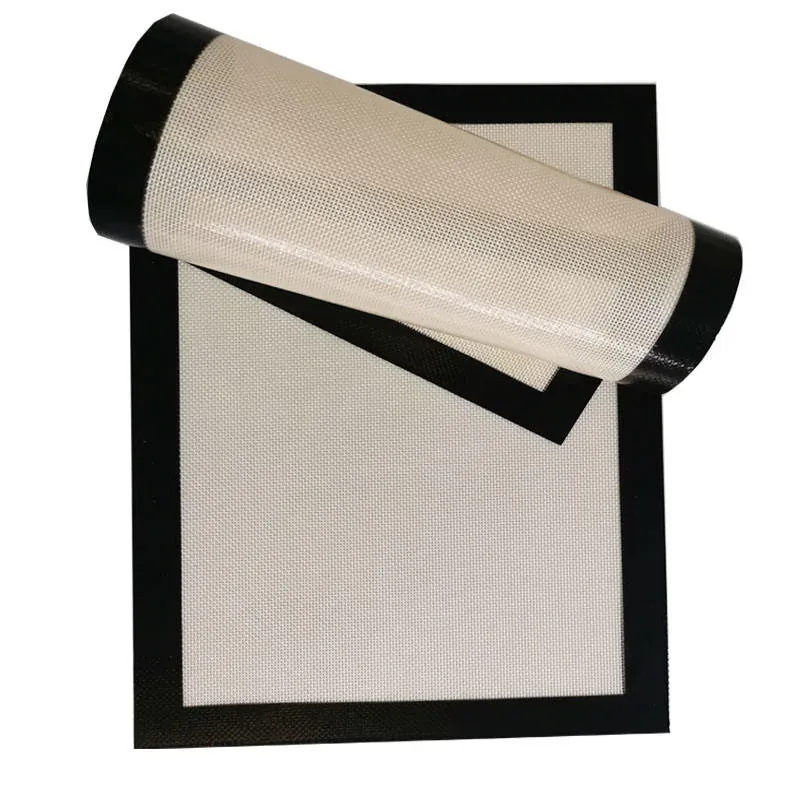
A silicone fiberglass baking mat has fiberglass reinforcement fully encapsulated in silicone, with a continuous working surface and a sealed perimeter. The weave can remain visible through the silicone, but there are no intentional through-holes. “Solid” refers to this closed surface; this product is not an unreinforced silicone rubber sheet.
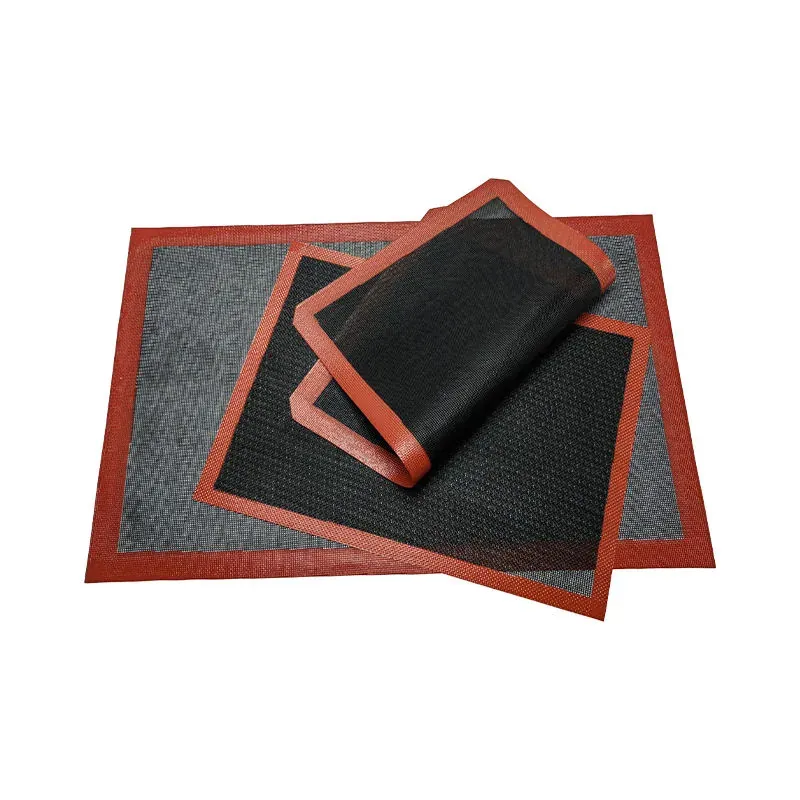
Silicone fiberglass baking mesh has silicone-coated fiberglass yarns with openings between them and a sealed silicone perimeter. It is also sold as a perforated silicone baking mat. The mesh openings remain open through the working area rather than being filled by a continuous silicone layer.
In both products, the glass fibers reinforce the mat and limit stretching; silicone provides the release surface. They can bend or roll for storage, but should not be stretched to fit a tray.
This comparison covers these two fiberglass baking constructions. Silicone-coated PET polyester steaming and dehydrator mesh is a separate product family with different operating limits.
02 / Baking mat comparison
Baking mat vs baking mesh: the practical differences
| Selection factor | Silicone fiberglass baking mat | Silicone fiberglass baking mesh |
|---|---|---|
| Construction | Fiberglass reinforcement fully encapsulated in silicone; continuous, non-perforated working area. | Silicone-coated fiberglass open mesh; sealed silicone perimeter. |
| Food support | Continuous support for soft mixtures, spreading dough and small pieces. A flat mat still needs a tray or mold to contain flowing mixtures at the edges. | For dough or shaped pieces that bridge the openings. Free-flowing batter, syrup and mixtures that press through the mesh need a closed support. |
| Airflow and moisture | No intentional through-openings beneath the food; moisture cannot escape through open mesh paths. | Openings provide paths for air and moisture. The supporting tray and food coverage determine how much of that path remains available. |
| Liquid and oil retention | The intact working surface retains liquid, oil and sugar residues above the mat. A flat border does not replace the sides of a rimmed tray. | Liquid, oil and small residues can pass through the openings. Use a continuous mat when preventing leakage is the priority. |
| Underside finish | Continuous contact surface; finish may be smooth or lightly textured depending on the selected mat. | Can leave a mesh pattern. Useful to trial when a drier base is wanted and that texture is acceptable. |
| Release | Silicone provides the release surface; results depend on recipe, coating condition and cooling. | Silicone-coated yarns provide the release surface; dough penetration into openings can make release harder. |
| Cleaning | Clean both faces and inspect the sealed perimeter. | Also remove residue from openings and yarn intersections without damaging the coating. |
| Dimensions to specify | Finished size, thickness, corner shape and sealed border. | Finished size, thickness, clear opening, usable mesh area and sealed border. |
03 / Baking mat comparison
Choose by dough behavior and the required base finish
A mesh surface can help moisture escape, but it does not guarantee a crisp base or a shorter baking cycle. Recipe, portion size, oven settings, tray and loading all affect the result.
Separate preparation from baking: rolling tart dough calls for a continuous work surface; baking the shaped shell may call for open mesh. Likewise, piped choux that holds its shape and a free-flowing batter have different support needs.
| Baking task | Start with | What to check |
|---|---|---|
| Soft or spreading cookies, meringues and flowing mixtures | Continuous silicone fiberglass baking mat | Spreading, release and underside finish. Use a rimmed tray or mold where edge containment is needed. |
| Caramel, melted chocolate and sugar-coated nuts | Continuous silicone fiberglass baking mat | Retention during pouring or depositing, cooling and release. Confirm the contact temperature and keep cutting tools off the mat. |
| Shaped bread, buns, croissants and puff pastry | Silicone fiberglass baking mesh when a drier underside is the aim | Dough support, mesh imprint, base color and release on the intended tray. |
| Tart shells with perforated tart rings | Silicone fiberglass baking mesh on a compatible perforated tray | Shell support and base finish. Liquid filling must be contained by the pastry or a suitable mold, not poured directly onto mesh. |
| Choux and eclairs | Fine baking mesh for a recipe that holds its piped shape | Whether the paste enters the openings, plus base formation, release and print-guide spacing. Use a continuous mat if the mixture cannot bridge the mesh. |
| Macarons and firm cookie portions | Trial continuous and fine-mesh constructions with the actual recipe | Foot or base formation, shape, sticking and texture. Do not assume all cookie doughs behave alike. |
| Rolling or handling dough on a work surface | Continuous silicone fiberglass baking mat | Required dimensions and surface grip. Keep cutting tools off the reinforced mat. |
04 / Baking mat comparison
Match the baking surface to the tray
A perforated tray can preserve an airflow path beneath baking mesh. A closed tray blocks direct through-airflow below the assembly, so placing mesh on it does not produce the same conditions as an open support. Compare the complete tray-and-liner combination.
A continuous mat on a perforated tray covers the airflow openings beneath its working area. Select that combination when continuous support is needed, rather than expecting the through-airflow of a mesh liner.
Both products are flexible liners. Confirm the required support under the loaded mat and do not assume either can bridge oven-rack gaps. Measure the usable inside base of the tray, including corners and clearance, before choosing the finished size.
05 / Baking mat comparison
Compare the two SIFMAT product specifications
The product ranges below apply to the selected fiberglass constructions. An open surface does not by itself confer a higher temperature rating. Confirm the finished mat, silicone system, print, edge construction and intended baking cycle together.
| Product | Thickness options | Temperature range | Working surface |
|---|---|---|---|
| Silicone Baking Mats | Typical development range: 0.4–2.0 mm; final thickness and tolerance are confirmed for the selected construction. | Recommended continuous operating range: -40°C to +230°C; short-term exposure and final limits depend on the selected construction. | Continuous non-perforated silicone surface |
| Silicone Mesh Baking Mat | Typical range: 0.5–1.0 mm; mesh opening, coating build and finished thickness are confirmed for the project. | Recommended continuous operating range: -40°C to +230°C; final limit depends on the selected silicone system and finished construction. | Open silicone-coated fiberglass mesh with sealed perimeter |
Select the product family first, then specify the finished size, tolerance and operating conditions for your order. Adhesives, printing and edge treatments may affect the finished part’s suitability.
06 / Baking mat comparison
Apply the temperature limit to the finished mat
The recommended continuous range listed for these two product families is -40°C to +230°C. Fiberglass reinforcement can withstand more heat than the silicone system, but its raw-material limit is not the operating limit of the finished baking mat. Any short-term exposure above the listed range needs separate confirmation for the selected construction and duration.
Use the mat on its intended support within the confirmed operating conditions. Keep it away from open flames and direct contact with heating elements. A baking liner is not a fire-protection mat or a heat-insulating pad.
07 / Baking mat comparison
Specify the working area and sealed border
For the continuous mat, specify finished thickness, surface finish and overall dimensions. For baking mesh, also specify the clear opening between coated yarns in both directions. Mesh count or yarn spacing alone does not describe the finished opening after coating.
Opening size and open area describe different things: the first is the clear gap between yarns; the second is the proportion of the working area that is open. A larger opening may provide more passage but less support for soft dough. Specify both where they matter, and check the finished coated sample rather than a nominal mesh name.
Include border width in the drawing: the overall mat size includes the sealed perimeter, while the usable mesh area sits inside it. Agree logo and baking-guide positions together with the working area. Order the finished shape with its sealed edge rather than trimming a fiberglass mat to fit.
- State size and quantity per variant, including corners and border color.
- Include the tray type, dough or batter, normal temperature and baking duration.
- Identify printing, packaging and food-contact documentation required for the destination market.
08 / Baking mat comparison
Plan custom sizes around the finished construction
Changing a fully encapsulated mat can affect the body, forming or tooling, and the sealed perimeter together. Baking mesh is made from coated open mesh and finished with a silicone border; changing its size is a different request from developing a new mesh, coating or edge structure.
Separate the quantity per size from requirements for new colors, mesh specifications, printed guides and retail packaging. The two custom-product guides below list the corresponding options and MOQs. Compare the same finished size, construction and packing when evaluating quotations.
09 / Baking mat comparison
Care for the silicone coating and fiberglass structure
Let the mat cool, then clean with warm water, mild detergent and a soft sponge in accordance with its care instructions. A soft brush can help remove dough from mesh openings. Clean both faces and the border, rinse and dry before storing flat or loosely rolled.
Avoid knives, metal scrapers, steel wool, abrasive cleaners and sharp folds that can damage the coating or reinforcement. Confirm dishwasher cycles or stronger cleaning chemicals for the finished product before using them routinely.
Inspect the surface and sealed edges before reuse. Remove a mat from service if the coating is torn, the border separates or fiberglass becomes exposed. Cutting through either construction can expose the reinforcement.
10 / Baking mat comparison
Inspect the construction before the baking trial
| Check | Continuous baking mat | Baking mesh |
|---|---|---|
| Surface and reinforcement | Continuous silicone coverage on both faces; no cuts, peeling or exposed fiberglass. | Coated yarns without torn mesh, exposed fibers or visibly missing coating. |
| Perimeter and corners | Complete sealed perimeter with no gaps or separation. | Sealed border joined to the mesh without cracks, notches or separation. |
| Working area | Agreed finish and print placement; no unintended holes. | Consistent openings without blockage or excessive skew; artwork preserves the required open area. |
| Tray fit | Check length, width, corners, body and border thickness against the approved drawing. | Also check border width and usable mesh area, then lay flat on the intended tray. |
11 / Baking mat comparison
Approve the choice with a baking trial
- Use the same recipe, portion weight, tray, oven settings and cooling method for the first comparison.
- Record spreading or sagging, base color, mesh marks, release and the bake endpoint.
- Check the mesh for dough penetration and inspect both products after cleaning.
- If you change the tray or baking cycle, record that as a separate trial so the cause of any improvement stays clear.
- Approve the construction, finished dimensions, border and artwork against the sample identifier before ordering.
Your next step
Choose a Baking Mat or Baking Mesh
Send the tray dimensions and type, recipe or dough consistency, baking temperature and duration, desired underside finish and quantity. We can review the continuous silicone fiberglass mat and open fiberglass baking mesh against the same brief.
Choose a Baking Mat or Baking Mesh