Quick answer
Choose a dehydrator mesh sheet that retains the smallest pieces, supports food as it softens and shrinks, and leaves a flow path through the loaded tray. Specify the clear opening after coating together with pitch, geometric open area and edge finish. Then confirm the finished material for the drying and cleaning cycle. Larger holes or a higher open-area percentage alone do not establish faster drying.
01 / Dehydrator mesh selection
Start with the food and the loaded tray
A mesh that looks open and easy to clean can still be the wrong support for a production batch. Soft fruit may press into the openings; small herbs may fall through; a mesh laid over a closed metal tray has no continuous through-air path below it. Selection starts with the complete arrangement of food, mesh, tray and dryer.
Record the smallest pieces, slice thickness, fresh and dried dimensions, softness, surface stickiness and load per tray. Include any fragments generated during unloading. A firm piece at loading may become soft during processing and smaller at the endpoint, so a comparison against its initial size alone is incomplete.
| Decision | What to establish | Why it changes selection |
|---|---|---|
| Retention | The smallest pieces and fragments that must remain on the sheet. | An opening must be judged against the product throughout the cycle, not only at loading. |
| Support | How soft the food becomes, how much imprint is acceptable and how far the sheet spans between supports. | A mesh may retain a piece but still allow sagging, marking or difficult release. |
| Flow path | The tray openings, airflow direction, tray spacing and loaded coverage. | Mesh openings cannot provide through-flow where food or a closed backing blocks the path. |
| Finished construction | Coating, reinforcement, edges, operating exposure and cleaning. | Geometry alone does not establish heat resistance, durability or food-contact suitability. |
02 / Dehydrator mesh selection
Aperture, pitch and mesh count describe different things
Clear aperture is the unobstructed gap between the coated strands in the finished sheet. Specify both directions: opening X × opening Y. A supplier’s uncoated mesh specification may not equal the opening remaining after silicone or PTFE coating.
Pitch is the repeat distance between corresponding points on adjacent strands. In an ideal regular grid, pitch equals the clear opening plus the projected coated-strand width in that direction. Measure these dimensions in the sheet’s agreed, unstretched condition. Pulling a flexible sample tight can change the apparent opening and squareness.
| Term | Definition | Purchasing implication |
|---|---|---|
| Clear aperture, aₓ × aᵧ | The open width and length between coated strands. | Request actual finished openings, their variation and any blocked openings. |
| Pitch, pₓ × pᵧ | Repeat spacing in each direction. | Useful for checking the pattern and calculating geometric open area. |
| Coated strand width, sₓ and sᵧ | Projected width occupied by the strand and coating in each direction. | Do not substitute bare-fiber diameter or overall mat thickness. |
| Geometric open area | Open area divided by the projected area being considered, expressed as a percentage. | State whether the value describes the active mesh or includes a closed border. |
| Mesh count | Number of repeats per stated unit length, under a declared counting convention. | Ask for units and convention. A count without strand dimensions does not define the aperture. |
| Overall thickness and GSM | Finished thickness and mass per unit area. | Record separately; neither is a substitute for aperture, stiffness or open area. |
03 / Dehydrator mesh selection
Calculate geometric open area before comparing samples
For a regular rectangular grid, one repeat cell has projected area pₓ × pᵧ and an opening of aₓ × aᵧ. Its geometric open area is (aₓ × aᵧ) ÷ (pₓ × pᵧ) × 100%. For a square grid, this reduces to [a ÷ (a + s)]² × 100%.
Use finished coated dimensions in the same units. The calculation below describes an ideal, flat grid. Uneven coatings, distorted openings and blocked intersections require measurements of the actual sample. An average aperture alone can hide variation that matters for product retention.
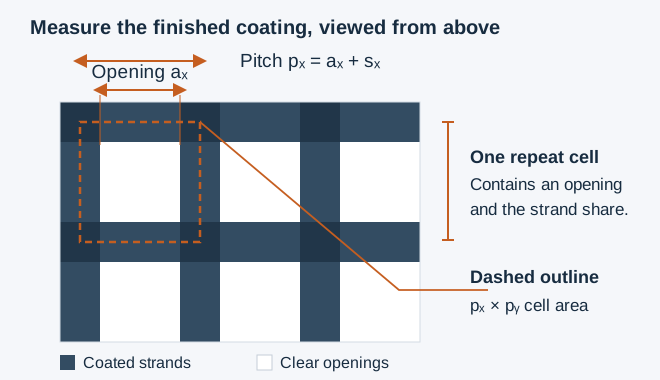
Open area (%) = (aₓ / pₓ) × (aᵧ / pᵧ) × 100
pₓ = aₓ + sₓ; pᵧ = aᵧ + sᵧ
Ideal regular grid only. This result does not predict airflow, drying time, mechanical strength or a suitable food size.
| Example | Clear aperture | Coated strand width | Pitch | Geometric open area |
|---|---|---|---|---|
| A | 1.0 × 1.0 mm | 0.5 mm in both directions | 1.5 × 1.5 mm | 44.4% |
| B | 1.0 × 1.0 mm | 1.0 mm in both directions | 2.0 × 2.0 mm | 25.0% |
| C | 2.0 × 2.0 mm | 1.0 mm in both directions | 3.0 × 3.0 mm | 44.4% |
04 / Dehydrator mesh selection
Open area is not an airflow or drying-time rating
Geometric open area describes a two-dimensional opening pattern. Air permeability describes flow through the material under stated conditions, such as a defined pressure difference. Pressure drop describes the resistance at a stated flow condition. These measurements answer different questions and need their own units and test conditions.
A larger geometric opening fraction provides more unobstructed projected area, but the loaded system also includes coating profile, mesh thickness, the supporting rack, food coverage, airflow direction and the fan’s operating point. Two sheets with the same open area therefore need not have the same flow resistance or drying result.
Increasing fan flow does not necessarily improve every position equally. When comparing samples, keep tray spacing and food layout consistent, and record the inlet, center and outlet positions relevant to your dryer. Assess all samples at the same agreed product endpoint rather than declaring the sheet with the shortest observed time best regardless of final condition.
- If the supplier reports permeability, request the pressure difference, units, method and specimen condition.
- Distinguish an empty-sheet measurement from observations on a loaded tray.
- Record blocked openings before and after cleaning; geometric dimensions do not describe residue buildup.
- Assess drying time alongside product retention, release, usable yield and cleaning effort.
05 / Dehydrator mesh selection
Balance food support against the opening pattern
Choosing a larger opening is a tradeoff, not an automatic upgrade. A soft piece can deform into an opening even when its overall length is much greater than the aperture. Long, thin fragments can also orient differently during handling. Thickness, texture and shape matter alongside the smallest dimension.
The coated strands form the contact network beneath the food. With comparable materials and support, a finer pattern can give a soft product more frequent contact points, while leaving more intersections to inspect and clean. Determine whether the underside imprint and release force are acceptable with the actual food and cooling or unloading procedure.
| Food condition | Selection concern | Observe during the trial |
|---|---|---|
| Fruit and vegetable slices | Softening, shrinkage, underside imprint and sticky surfaces. | Check the thinnest slices, edge fragments, sagging and release at the agreed unloading condition. |
| Herbs and small pieces | Particle loss through openings and during handling. | Collect and record lost fragments during loading, drying and removal. |
| Jerky strips and pet treats | Shape variation, soft loading condition, residues and cleaning access. | Use the smallest and softest pieces in the batch; inspect intersections after the wash cycle. |
| Soft formed pieces | Penetration and mechanical locking around strands. | Compare fine mesh with a continuous liner where retention is more important than through-flow. |
| Puree or flowing mixture | Leakage through the working surface. | Use a continuous liner and assess tray containment and the actual drying route. |
06 / Dehydrator mesh selection
Specify tray support, working area and edge clearance
A flexible sheet is not a substitute for a load-bearing rack. Record the spacing and layout of the supports below it, and check the sheet with the intended load. Sagging between supports can change product contact, handling and clearance even when the mesh aperture is suitable.
Distinguish overall sheet dimensions from the usable working area. A closed border occupies space and may cover some tray openings. Curled corners, overhanging edges and a sheet that rides up the tray wall can obstruct handling or approach equipment surfaces that the material was not specified to contact.
The mesh and tray openings do not simply multiply into a reliable system airflow figure. Their alignment, spacing and the food load affect the combined path. Inspect the installed arrangement and evaluate it under the actual dryer conditions.
- Provide the tray’s clear internal dimensions, corner shape, opening layout and support spacing.
- Specify finished sheet size, dimensional tolerance, usable area and any border width.
- Check fit before loading and again after a complete processing, cooling and cleaning cycle.
- Confirm the edge treatment for the supplied construction. Do not cut a sealed fiberglass mat and assume the cut edge retains the original protection.
07 / Dehydrator mesh selection
Select the coating and reinforcement for the complete cycle
Silicone-coated PET polyester mesh is a separate construction from silicone-coated fiberglass baking mesh. PET mesh is a starting point for drying, steaming and drainage projects within the confirmed finished-grade limits. A silicone coating does not transfer the operating rating of a fiberglass oven mat to a PET sheet.
PTFE-coated fiberglass open mesh is another option for processes that call for a low-friction release surface and suitable glass reinforcement. Compare the actual grade, edge treatment, tray arrangement and cleaning method; the polymer name alone does not identify an equivalent replacement.
The catalogue values below help identify a product family. Confirm normal and peak exposure, duration, contact mode and the complete finished sheet. A catalogue temperature range does not establish repeated steam life, suitability for a particular cleaner or the performance of a different edge construction.
| Product | Thickness options | Temperature range | Working surface |
|---|---|---|---|
| Silicone-Coated PET Mesh Dehydrator Mats | Overall thickness is specified with mesh opening, open area and finished GSM; values require confirmation for the selected construction | Operating range: -40°C to +160°C. Use this product for steaming, drying and drainage applications within that range; it is not a default high-temperature oven-baking material. | Open silicone-coated mesh with good release performance and drainage |
| Large-Opening Silicone-Coated PET Mesh Dehydrator Mat | Overall thickness is specified with mesh opening, open area and finished GSM; values require confirmation for the selected construction | Operating range: -40°C to +160°C. Use this product for steaming, drying and drainage applications within that range; it is not a default high-temperature oven-baking material. | Large-opening silicone-coated mesh with good release performance and drainage |
| PTFE Coated Fiberglass Mesh Conveyor Belt | Typical mesh grades vary by aperture, fiberglass construction, PTFE coating weight and edge finish; final values require supplier confirmation. | Recommended continuous operating temperature: up to 260°C / 500°F for the selected PTFE-coated fiberglass mesh. Direct flame contact is not recommended. | Open PTFE-coated fiberglass mesh release surface |
Select the product family first, then specify the finished size, tolerance and operating conditions for your order. Adhesives, printing and edge treatments may affect the finished part’s suitability.
08 / Dehydrator mesh selection
Approve a mesh with a controlled sample comparison
Assign each sample an identifier and record its construction before processing. To investigate aperture, compare samples with similar coating, reinforcement, thickness and support where possible. If several variables change together, the trial can choose a finished sheet but cannot isolate which variable caused the difference.
Hold the recipe, slice thickness, initial product condition, tray load, layout, dryer settings and endpoint criteria consistent. Use equivalent positions or repeat the comparison across positions so a location advantage is not mistaken for a mesh advantage. Record departures from the planned conditions.
| Stage | Record | Decision supported |
|---|---|---|
| Before use | Sample ID, coated opening and pitch, overall size, flatness, blocked holes, coating and edge condition. | Does the supplied sample match the intended construction and drawing? |
| Loaded handling | Tray support, load, placement, sagging, particles lost and clearance. | Can the sheet retain and handle the actual product? |
| Processing | Time, temperature profile, tray position and the same agreed product endpoint. | How does the candidate perform under comparable cycle conditions? |
| Unloading | Sticking, torn pieces, fragments, underside imprint and product loss. | Is release and finished appearance acceptable? |
| After cleaning | Residue at intersections, blocked openings, coating integrity, edges and cooled dimensions. | Can the approved cleaning procedure restore an acceptable sheet? |
| Repeated cycles | Number and duration of cycles, any changes in release, dimensions or damage. | Is there evidence for the intended repeat-use duty? |
09 / Dehydrator mesh selection
Use the observed problem to guide the next change
Treat the observations below as prompts to investigate. Similar symptoms can have several causes; changing to a coarser mesh or a thicker sheet without checking the process can miss the underlying issue.
| Observation | Check first | Next comparison |
|---|---|---|
| Pieces or fragments fall through | Finished aperture, piece dimensions at the endpoint and handling orientation. | Trial a finer opening or continuous support where needed; compare losses throughout the cycle. |
| Soft food sinks into the mesh | Food softness, opening shape and support spacing. | Compare a finer contact pattern or closer tray support, keeping load and recipe consistent. |
| Underside remains wet or varies by position | Closed backing, food coverage, tray spacing, airflow path and position. | Evaluate the installed flow path before assuming the aperture is the cause. |
| Release becomes difficult | Residue, food entering the openings, coating condition and unloading temperature. | Compare a clean undamaged sample under the same conditions and review the approved cleaning method. |
| Openings stay clogged after washing | Residue type, intersection access and cleaning conditions. | Review cleaning compatibility and recovery; do not solve blockage by scraping through the coating. |
| Sheet curls or changes size | Drying and wash exposure, support, storage and the selected reinforcement. | Measure the cooled sheet against its initial record and confirm a construction suited to the cycle. |
| Loose strands, coating separation or exposed reinforcement | Both faces, edges and intersections. | Remove the damaged sheet from product-contact service and review replacement with the supplier. |
Buyer questions
Dehydrator mesh selection questions
What mesh size is best for a food dehydrator?
There is no single aperture that suits all foods and trays. Start with the smallest pieces and how they soften, shrink and release. Specify the finished clear opening, pitch and open area, then trial the sheet with the actual tray, load, cycle and cleaning method.
Does a larger mesh opening always dry food faster?
No. Larger openings can provide a less obstructed projected path but may reduce support or lose small pieces. Drying also depends on the tray, food coverage, airflow, temperature and endpoint. Compare candidates under equivalent loaded conditions.
Can two mesh sheets have the same open area but different openings?
Yes. In the illustrative square grids above, a 1.0 mm opening with 0.5 mm strands and a 2.0 mm opening with 1.0 mm strands both calculate to 44.4% open area. Their retention and contact patterns differ. The equal percentage does not establish equal airflow or load capacity.
Should open area include the closed border?
State the area used. Active-mesh open area describes the mesh pattern; whole-sheet open area also accounts for any closed border. Ask for usable working dimensions and border width so the two definitions are not mixed.
Can silicone-coated PET mesh be used as an oven baking mat?
Do not assume it can. The polyester reinforcement, coating and complete finished construction must be confirmed for the intended cycle. PET drying mesh and fiberglass baking mesh are separate families; the silicone surface alone does not give them the same operating limit.
Can I cut a finished mesh sheet to fit my tray?
The answer depends on its reinforcement and edge finish. Specify the final size and edge with the supplier. Cutting a sealed fiberglass mat removes the protective perimeter; a PET cut-sheet format also needs the appropriate edge and handling conditions confirmed.
Your next step
Discuss Your Dehydrator Application
Tell us what you dry, your tray size, drying conditions and quantity. We can help you choose a mesh to evaluate.
Discuss Your Dehydrator Application